
Video Game Development · Gaming Industry
How to Make Game Worlds Feel Alive Without Bloated NPCs
How do we make a world feel alive without making every NPC expensive to build and maintain? That question sits at the center of modern immersive game design. We want players to sense real...
How do we make a world feel alive without making every NPC expensive to build and maintain? That question sits at the center of modern immersive game design. We want players to sense real presence, real history, and real consequence, but we also know that lifeless routines and bloated content pipelines can drain a project fast.
For us at MindMakerz, the answer is not to keep adding more stuff. It is to design smarter systems that create depth, surprise, and personality with less waste. That shift matters because a world does not feel alive simply because it is full. It feels alive when its systems interact in ways that suggest memory, intent, and change.
Why More Content Is Not the Same as More Life
It is easy to equate immersion with volume. More NPCs. More dialogue. More routines. More handcrafted moments. But more content can quickly become more overhead, especially when every character needs unique behavior, maintenance, and tuning. The result can be a world that looks busy on paper but still feels static in play.
A living world needs more than density. It needs relationships between systems. It needs enough structure to feel coherent and enough variation to keep players curious. That is where smarter design starts to outperform brute-force content creation.
Designing Depth Through Smarter Systems
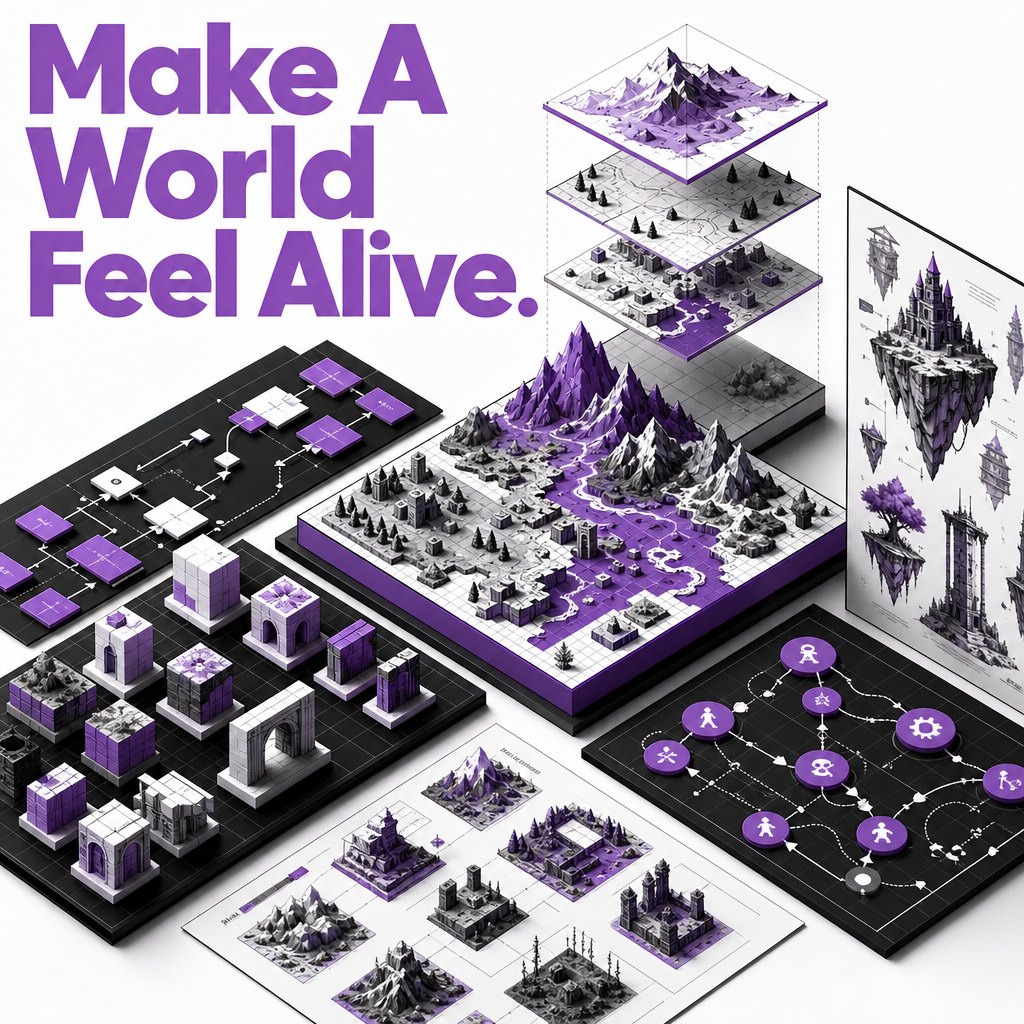
Our focus is on building systems that do more with less. Instead of treating every NPC as a separate expensive problem, we look for ways to create shared logic, reusable behaviors, and emergent combinations that can still feel personal.
This approach helps us shape worlds that respond in ways players can read and remember. A character does not need an oversized feature set to feel meaningful. A location does not need endless bespoke detail to suggest history. What matters is whether the world can imply consequence through how its pieces connect.
That is where smart systems become a creative tool, not just a technical one. They let us build spaces that can surprise players without demanding a mountain of handcrafted maintenance behind every interaction.
Presence, History, and Consequence
When we talk about immersion, we are really talking about three things: presence, history, and consequence. Presence tells players they are not alone. History tells them the world existed before they arrived. Consequence tells them their actions matter.
NPCs are one of the clearest ways to communicate all three, but they are not the only way. Worldbuilding can carry the same weight when systems are designed to reflect change, scarcity, routine, or tension. A world feels more alive when it can signal that things happen beyond the player’s immediate view.
That is the kind of depth we aim for at MindMakerz: not just handcrafted detail, but structured meaning. Not just activity, but believable motion.
The Real Challenge for Indie Teams and Studios
For indie game developers and studio leads, the challenge is balancing ambition with sustainability. Every extra NPC feature, every unique route, every custom behavior has a cost. If that cost grows faster than the experience it creates, the project starts to lose momentum.
So the real question is not how many systems we can add. It is which systems create the most life per unit of effort. Which mechanics help the world feel reactive? Which patterns create personality without requiring endless manual upkeep? Which interactions can be reused in different contexts while still feeling fresh?
That is the design space we care about most: rich worlds built with intention, not excess.
How are we solving that in our worlds right now? Reply with your biggest NPC or worldbuilding challenge.