
Video Game Development · Gaming Industry
Why Better NPC Memory Beats Perfect Recall
One of the easiest mistakes in game character memory is trying to store everything. It sounds impressive on paper, but in practice it often makes NPCs feel less alive, not more. A character that...
One of the easiest mistakes in game character memory is trying to store everything. It sounds impressive on paper, but in practice it often makes NPCs feel less alive, not more. A character that remembers every line, every event, and every interaction with equal weight starts to feel like a database wearing a costume.
At MindMakerz, we think the better question is not what can this character remember? It is what should this character actually carry forward? That shift changes memory from a technical checklist into a design tool. Instead of forcing perfect recall, we can build priority memory: a system that keeps the details that matter to the role, the world, and the next likely action.
Memory Should Match the Character’s Job
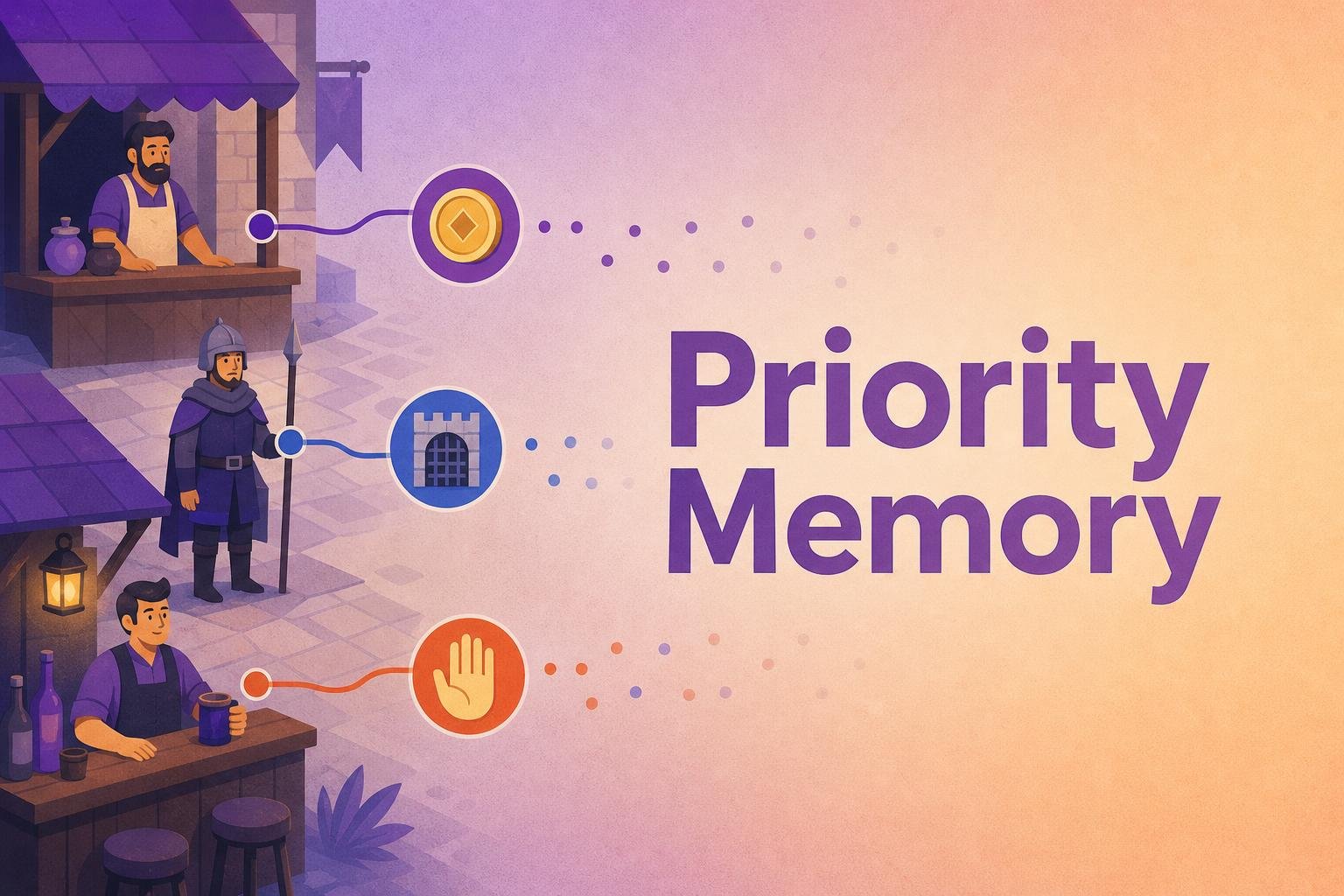
A shopkeeper remembering a theft makes sense. A guard remembering a warning makes sense. A bartender forgetting a throwaway line from hours ago also makes sense. These examples are not about making NPCs dumber. They are about making them more believable by aligning memory with function.
When a character’s memory reflects its role, the world starts to feel readable. Players do not need every NPC to act like a perfect archive. They need each NPC to retain the right kind of information. That is what makes a world feel authored instead of automated.
This is especially useful for indie game developers and studio leads who are building immersive worlds with limited time and resources. A memory system does not need to simulate everything to feel rich. It needs to support the behavior players are meant to notice.
Priority Memory Creates Better Gameplay Signals
Priority memory asks a simple design question: what did the character see, what matters to its job, and what is likely to be repeated later? That framing keeps memory focused on gameplay value instead of raw storage. If a courier was blocked at the gate yesterday, that detail can shape today’s route. The memory matters because it changes behavior.
On the other hand, if that same courier keeps repeating the same complaint forever, the system stops feeling human and starts feeling mechanical. Repetition without relevance is one of the fastest ways to make an NPC feel scripted. Players notice when a character is technically remembering, but not meaningfully adapting.
That is why relevant recall reads as intelligence. Players do not usually admire perfect recall. They respond to memory that feels selective, contextual, and useful. A character that remembers what matters feels like it has judgment, not just storage.
Designing for Believability, Not Exhaustion
There is a temptation in game design to treat memory as a completeness problem. If we can store more, surely the system becomes better. But memory in games is not valuable because it is exhaustive. It is valuable because it creates the feeling that characters exist beyond the current dialogue box.
That feeling comes from restraint. A character does not need to remember everything to feel real. It needs to remember the right things, at the right time, for the right reasons. That is the design choice worth making: not more memory, but better memory.
For teams exploring NPC behavior, worldbuilding, and systemic storytelling, this approach keeps the design grounded and expressive. It helps us build characters that feel like they belong in the world, not just inside a script. For more on our approach to game design systems, visit our game design work.
In the end, memory is not about proving how much an NPC can hold. It is about showing players that the character understood what mattered. That is where immersion starts to click.